
Roof Age & the Bond: What Gets Negotiated | The Villages®

Most deals around here used to come apart over price. Lately they come apart over two line items that have nothing to do with the list price — the age of the roof and the balance on the bond.
Both are negotiable. Both are badly understood, including by people who have bought and sold here before. And both reward whoever walks into the conversation knowing the actual rules instead of the version everybody repeats at the pool.
Part one: the roof, and what Florida law actually says
Here is the version you have probably heard: once your roof hits fifteen years, you are uninsurable.
That is not what the law says. It is close to the opposite.
Florida Statute §627.7011(5) sets a floor that protects homeowners, and it has been in place for every policy issued or renewed since July 1, 2022:
- If your roof is under 15 years old, an insurer cannot refuse to issue or renew your policy solely because of the roof's age. Full stop.
- If your roof is 15 years or older, the insurer must let you get an inspection from an authorized inspector — at your expense — before it can require a roof replacement as a condition of writing or renewing the policy.
- If that inspection finds five or more years of useful life remaining, the insurer cannot refuse to issue or renew solely because of the roof's age.
One more piece that matters more than people realize: the statute measures roof age from the last date 100 percent of the roof surface was built or replaced to code. If you had partial work done that eventually covered the whole surface, the clock runs from when that work started — not from the original build.
So a 2005 home in this market, with a roof replaced in 2014, is not the lost cause the rumor mill says it is. And a 19-year-old roof that passes inspection with five years of life left is not an automatic denial either.
What carriers actually do, which is a different question
The statute sets a floor. It does not set carrier appetite, and that is where the real friction lives.
Plenty of private carriers simply decline to quote new business on older asphalt shingle roofs as an underwriting preference. That is legal — declining to quote is not the same as refusing to issue over age alone, and a carrier can also decline over roof condition rather than age. What the statute stops is the specific move of pointing at the birthday and nothing else.
The practical consequence: an older roof rarely makes a home uninsurable. It makes it expensive and slow to insure, and it narrows the list of carriers who will look at it. On a 30-day close, slow is its own problem.
The part that actually costs money: ACV versus RCV
This is the piece almost nobody negotiates, and it is usually worth more than the roof credit everyone argues about.
Replacement cost value (RCV) pays what it costs to put a new roof on, minus your deductible. Actual cash value (ACV) pays the depreciated value — what the old roof was worth the day before the storm, minus your deductible.
On an older roof, many carriers will write the policy but only on an ACV basis. The policy looks fine on paper. Then a hurricane takes the roof off, and the check covers a fraction of the replacement.
If you are buying, the question is not "can I get insurance." It is "can I get insurance that would actually replace this roof." Those have different answers and different prices.
What to do about it
If you are selling: get an insurance quote on your own house before you list. Not a guess, a quote. If it comes back ugly, you want to know that in your kitchen in November, not in a buyer's inspection objection in January when you have already packed.
If you are buying: get a quote during your inspection period, before your financing contingency expires. And ask specifically whether the roof is covered at replacement cost or actual cash value. If the answer is ACV, that is a real cost and it belongs in the negotiation.
Part two: the bond, and the thing nobody tells you
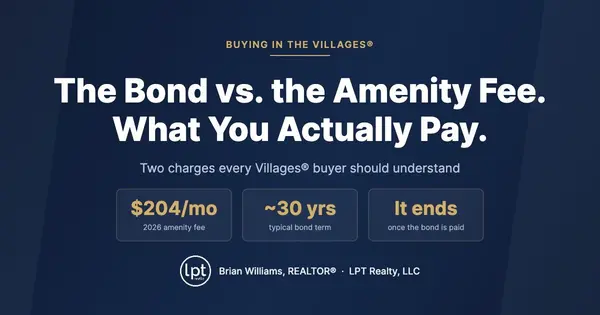
If you are new to this, the short version: homes here carry a Community Development District bond — a share of what it cost to put in the roads, utilities, drainage and recreation before anyone moved in. It shows up as an annual assessment on the property tax bill, on its own line, separate from the maintenance assessment and separate from the monthly amenity fee. If you escrow your taxes, you have been paying it without ever seeing a bill. (I wrote a fuller breakdown of the bond, the CDD and the amenity fee in this post on what moving here actually costs.)
Here is the part that surprises people on both sides of the table:
Nobody is required to pay the bond off at closing.
The bond attaches to the property, not to the owner. A buyer can take the house with the bond intact and keep paying the annual assessment exactly as the seller did. Heirs inherit it the same way. There is no law, no closing requirement, and no title issue that forces a payoff.
What there is, is a market. Bond-paid homes move faster. Homes with a balance outstanding generally list at a discount or sit longer, and appraisers notice — comparable sales here split between bond-paid and bond-outstanding, and treating them as interchangeable is how a deal gets an appraisal surprise.
So should a seller pay it off?
It is an arithmetic question, not a moral one, and it comes down to two numbers: the interest rate on your bond and how long you expect to own the home.
Prepaying stops the interest. If your bond carries a high rate and you have years left on it, prepaying can be worth more than the cash it costs. If the rate is low, or the balance is nearly retired, handing the buyer a price credit of the same size usually nets you better — it is the same money to them and less money out of your pocket today.
Either way, the move is the same: pull your parcel's bond record before you list. Balance, rate, and years remaining. Go to your district's website or call the district office. Do not guess, and do not go off what your neighbor's was — these vary enormously by village and by home.
I have watched sellers discover a bond balance on the closing statement. It is not a good day. It is entirely avoidable with one phone call six weeks earlier.
Part three: what it looks like when both land at once
Here is the deal I see most often right now.
Buyer loves the house. Inspection comes back fine structurally, but the roof is seventeen years old. Buyer's insurance quote comes back high, and ACV. Then the buyer's agent pulls the parcel record and finds an unpaid bond balance.
Now there are two asks on the table, and a seller who has not thought about either one is negotiating from behind, under time pressure, with a buyer who has already decided both are the seller's problem.
The seller who handled both before listing — quote in hand, bond record pulled, a decision already made about prepay versus credit — is having a completely different conversation. Usually a shorter one, at a better number.
That is the whole argument for doing this early. Not because it changes the facts about your house. Because it changes who is reacting.
Three things worth doing this week
- Find out how old your roof actually is — and specifically, the last date the whole surface was replaced to code. Permit records will tell you if your paperwork won't.
- Get an insurance quote on your own home, even if you are not selling for a year. Ask whether the roof would be covered at replacement cost or actual cash value.
- Pull your bond record. Balance, interest rate, years remaining. Ten minutes, and it is the single most common unpleasant surprise in a closing around here.
None of that costs anything but an afternoon, and all three of them are worth more in January than they are in June.
I am a REALTOR®, not an insurance agent or an attorney. The statute cited here is Florida Statute §627.7011; read it yourself or ask a licensed insurance professional about your specific policy, and talk to the district office about your specific bond. Carrier underwriting practices change constantly, and what was true for your neighbor's quote in March may not be true for yours in November.
If you want help thinking through what your roof and your bond mean for a sale — or whether now is even the right time — call or text me at (352) 978-1284. Straight answer, no pitch.
Brian Williams, REALTOR®
Brian David Williams, LLC · LPT Realty, LLC
bwsellsflorida.com
Categories
Recent Posts